Jet Support Services, Inc. (JSSI), the world’s leading provider of maintenance support and financial services to the business aviation industry, has released its Business Aviation Index, which tracks flight hours for business aircraft by region, industry and cabin type, providing powerful insights into the state of global economic conditions. With a slight increase in travel, the index affirms a “new normal” of modest but prudent business aviation travel.
According to JSSI’s Index, global flight hours during Q2 of 2016 showed growth of 4% over the previous quarter. This follows the cyclical trend of higher flight hours in the second quarter of a given year. While there was QoQ growth, there was also a 1.2% decline in flight hours YoY, compared to Q2 of 2015, which coincides with a trend JSSI has seen in past presidential election years of a “holding pattern” by corporations waiting to see the result of the elections. However, this is also consistent with the “new normal” for flight hours which is seen in the chart below for overall flight activity YoY. After the peak year in 2008 and subsequent plunge in 2009, there has been a relatively stable period overall from 2012 through 2016.
“Businesses are using private jets in a very disciplined manner today. This is not a stereotypical CEO perk, but a critical tool necessary to conduct business all over the world. Q2 2016’s flight activity, while slightly up over last quarter and down from last year, is reflective of a flat U.S. economy,” said Neil W. Book, JSSI’s President and Chief Executive Officer. “We are in a slow growth environment.”
JSSI Index: By Industry
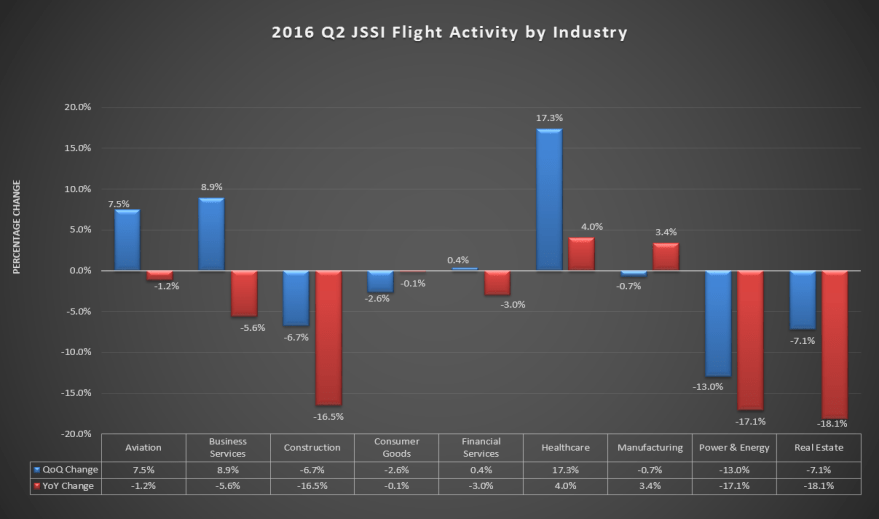 Aviation, Business Services, and Healthcare all experienced QoQ growth with the largest being a 17% increase for the Healthcare sector. Financial Services experienced virtually no change in flight hours compared to the previous quarter, but had sharp decreases in a YoY comparison. All other industries saw a decline in flight hours from the previous quarter. While only three out of the nine industries showed growth between the first and second quarter, a significant increase in hours flown by the Healthcare industry largely contributed to the overall positive average.
Book stated, “Over this quarter, oil prices rose from $38 to $48, but we saw a major decrease in flight hours in the power and energy sector as many energy companies have taken cost reduction measures to manage the significant decline in the price of oil over the last two years. A significant reduction in orders from China is hurting the construction industry as growth in the Chinese economy continues to slow. Factory activity rebounded from Q1 helping to maintain flight hours in manufacturing and consumer confidence rose to recent highs which could propel flight hours in the next quarter.”
JSSI Index: By Region
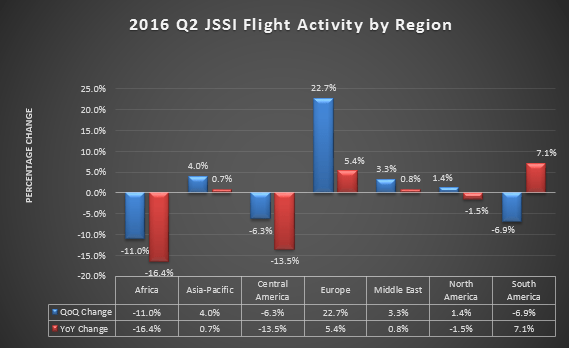 When looking at the data by region, Business Aviation experienced YoY growth in only two markets – Europe and South America. Of the seven regions, four (Asia-Pacific, Europe, Middle East, and North America) saw positive growth over last quarter. Of those four, only North America saw a decrease in utilization in comparison to this time period last year.
Analysis of utilizations on an annual basis show that the majority of regions have seen some stabilization over the past few years. With only slight changes since 2013 in the South American, Asia-Pacific, North American, and European markets, utilization has become less volatile per annum. On the contrary, Africa continues to see a steady decline in utilization since reaching highs in 2011, with five consecutive years of decreasing average flight hours the African market is showing little signs of recovery.
JSSI Index: By Aircraft Type
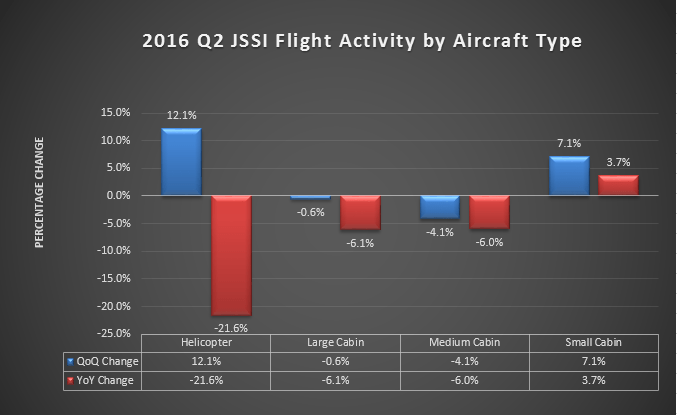 Q1 saw helicopter utilization hitting the lowest hours since 2011, but in Q2 the hours rebounded to a more normal level. As referenced earlier in this report, the major contributing factor to the decrease in helicopter utilization is the economic downturn in the power and energy sector as many oil companies still have large reserves and prices continue to be low and volatile. The decline in oil prices has had a negative impact on the helicopter sector which supports offshore operations and flight hours in the Middle East.
“Flight hours in the large cabin aircraft segment have seen a steady, but gradual decline since Q2 of 2011 and after experiencing its lowest first quarter since 2009, Q2 2016 saw more declines hitting all-time lows in average flight hours. This is consistent with the current prudent usage of corporate jets. Private aviation is not a frivolous expense, but rather a valuable business tool for an increasingly interconnected global economy,” continued Mr. Book.